The scientific foundations of Pollitics
Pollitics is grounded in a research program around exact synthetic population generation, latent-space modeling of observed structures, and the comparison of simulated signals with external results.
From aggregated statistics to coherent synthetic populations
The starting point is not a bag of fictional personas. It is a constrained generation problem: how to generate populations that respect observed demographic structures while avoiding implausible combinations, for example across age, profession, income, housing and political variables. This requirement applies to socio-demographic structures, but also to any other characteristics used to define a population, such as psychological profiles or purchasing behaviors.
From structured populations to virtual polling
Once a population remains coherent at the structural level, it becomes possible to query it through controlled language-model workflows. Pollitics uses that layer to surface reactions, objections, hesitations and framing effects, not to claim that one simulated answer equals one human fact.
Why it is important to discuss both validation and limits
A synthetic panel only becomes useful if its outputs remain interpretable against external references. That is why Pollitics is developed around validation benchmarks, correlation preservation and explicit limits: the objective is a serious exploratory instrument, not a black-box promise of certainty.
Scientific foundations
Pollitics is built on a line of research that combines exact synthetic population generation, latent-space modeling of observed structures, and comparison with signals drawn from human polling. The objective is not to claim perfect prediction of society, but to provide a scientifically grounded simulation layer that remains explicit about its scope and limits.
Exact synthetic populations
The first layer of the Pollitics stack is a constrained population generator. Rather than sampling isolated fictional respondents, the system builds synthetic populations under explicit demographic and structural constraints. In practice, that means age, profession, household structure, housing status, political variables, income, or any other characteristic are generated jointly under consistency requirements, instead of being stitched together independently.
A key part of this work is the introduction of a latent representation learned from real aggregate structures. The latent space does not replace the constraints; it complements them by helping the generator avoid implausible combinations and preserve the geometry of the original observed world.
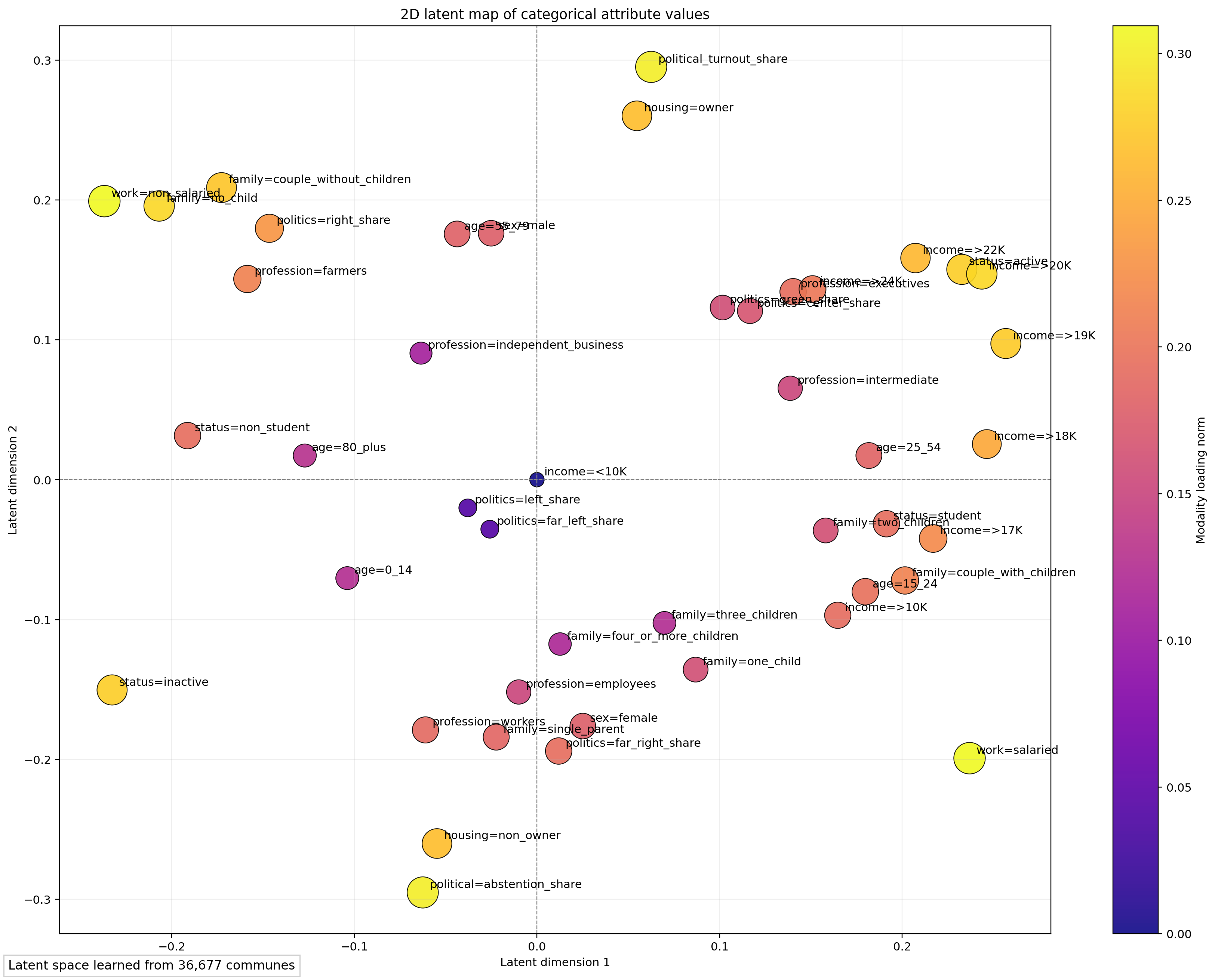
What matters here is not the exact coordinate of one label, but the visible organization of the space. High-income modalities group near executive professions and higher housing stability; family and age structures form their own local neighborhoods; political variables occupy positions that reflect the social contexts in which they usually appear. This is the type of latent regularity that helps Pollitics generate populations that remain coherent at the micro level.
External validation
A synthetic population is only useful if its downstream behavior remains intelligible when confronted with external evidence. For that reason, Pollitics also evaluates virtual polling outputs by comparing them with published human polling results. This comparison is not presented as proof that synthetic results equal human truth in all circumstances; it is used as a benchmark to assess whether the model stays directionally aligned on real public questions.
The example below comes from the question "Should people be able to take refuge in other countries to escape war or persecution?". The bars compare published IPSOS shares with virtual polling results obtained from synthetic populations generated by the Pollitics generation engine.
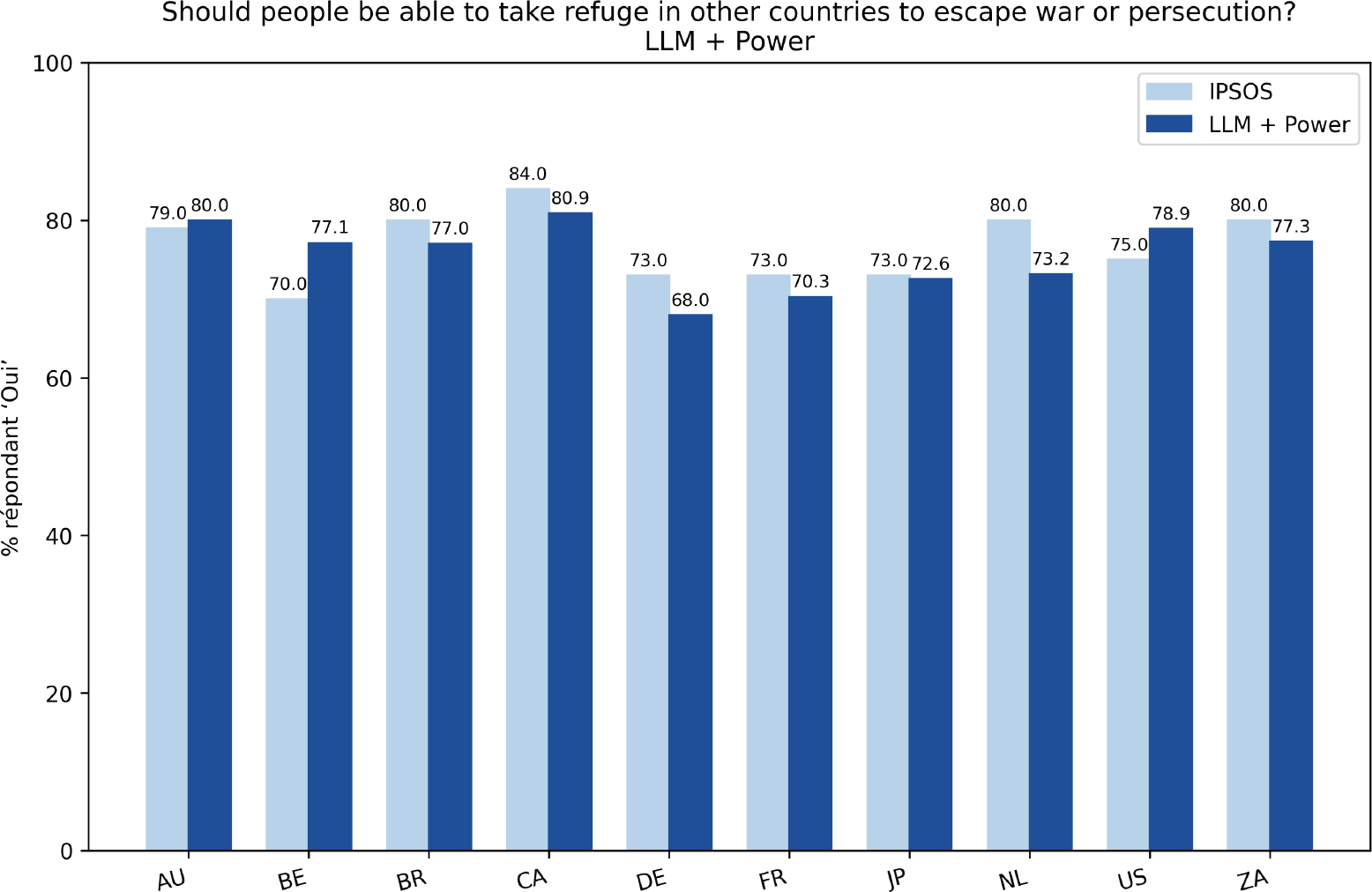
The important signal is the stability of the pattern across countries. The synthetic pipeline does not collapse into one generic answer; it preserves cross-country variation while staying close to the human benchmark on a highly interpretable public question. In methodological terms, this is evidence that the population layer and the behavioral querying layer interact in a way that remains externally legible.
Preserving correlations during synthesis
A frequent weakness of synthetic data systems is that they match marginals while quietly destroying the dependency structure between variables. Pollitics explicitly avoids that failure mode. The latent space is used not just to place modalities in an abstract geometry, but to preserve the patterns of co-movement that make a population realistic.
The following heatmap is one example of this kind of result on another dataset: even after synthesis, strong positive and negative correlations remain visible instead of being flattened away.
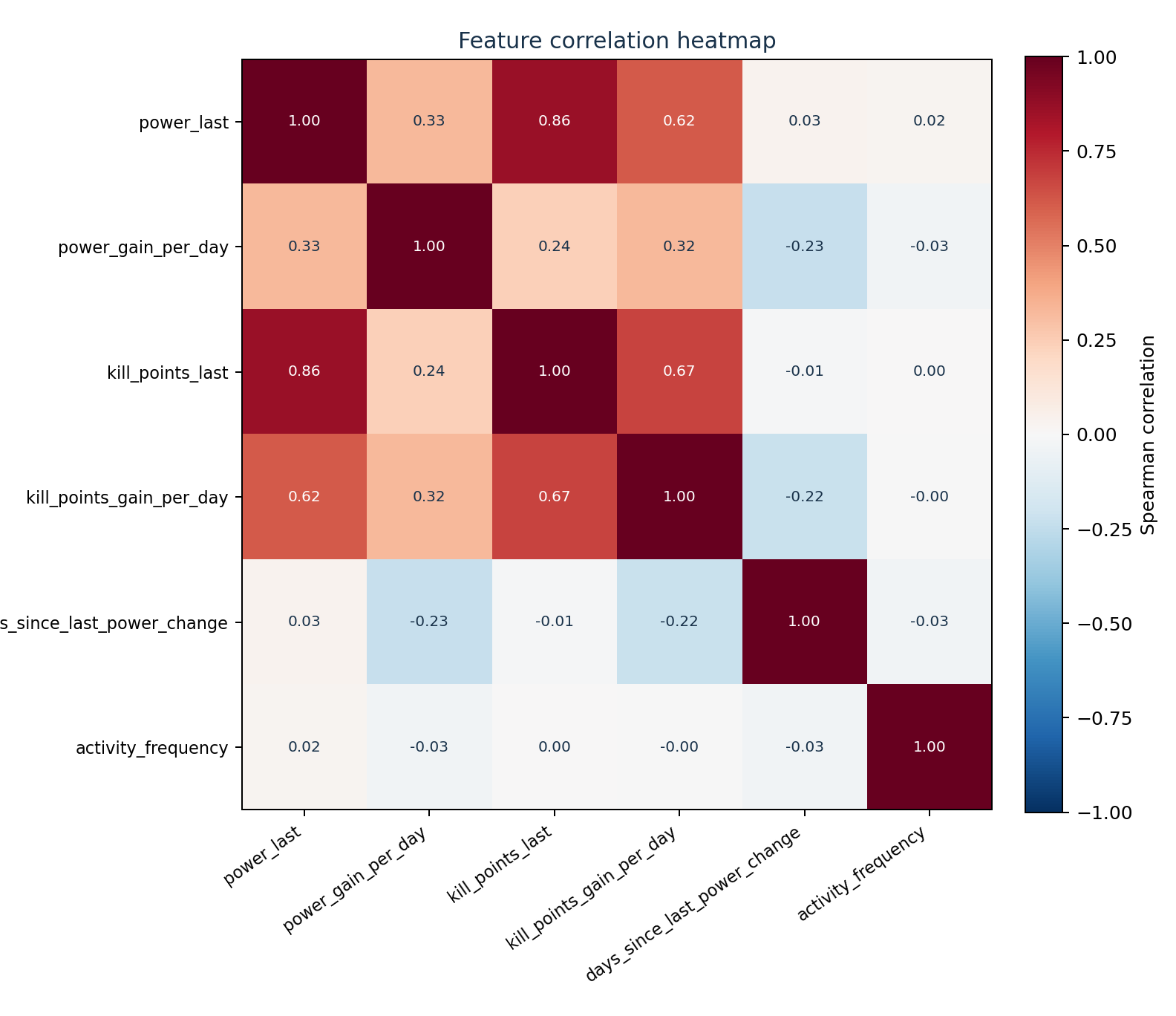
This kind of figure matters because it shows that the synthetic representation preserves relational structure, not just isolated variables. In plain language: the model remembers that some things tend to move together, while others move in opposite directions. That is exactly what a latent-space-guided synthesis process is supposed to do. It produces respondents and cohorts that are not only individually plausible, but also collectively structured in a way that remains analytically meaningful.
Scope and limits
These results do not imply that synthetic panels should replace every form of fieldwork or every high-stakes measurement protocol. They do show, however, that Pollitics is grounded in research programs with explicit validation logic, measurable error questions, and a transparent concern for preserving underlying structure.
- Synthetic respondents are not real people; they are structured simulations built from demographic and behavioral modeling choices.
- Benchmarks against human polling are used as checks of coherence and calibration, not as an excuse to overstate certainty.
- The scientific value of the approach comes from explicit constraints, latent structure preservation, and auditable validation workflows.
Associated publications
The full bibliography is available on the publications page.
Open publications pageFAQ
Does Pollitics claim to replace every human study?
No. Pollitics is positioned as a fast exploratory layer that helps teams test messages, offers, concepts and reactions earlier, not as a blanket replacement for all human research.
Why mention scientific work on a product site?
Because it clarifies the methodological roots of the product and helps readers understand synthetic panels as a documented approach rather than as a vague marketing term.